

How To Make A Custom Metadate Template In Capture One
Using metadata in Capture One is maybe not the near obvious part of your workflow. With some modest steps, y'all step into the world of IPTC. After a cursory introduction, you are set to give your photos a descriptive text to assist you to observe them when needed.

Using Metadata In Capture One
Metadata means information well-nigh data. In our case, the photo is the data, and metadata tells the viewer something about a photo.
Where and when was the photo fabricated? On what assignment, or which trip? Who are the people on the prototype? Who is the creator of the image, and how claims the copyright? These are just a few examples of metadata.
Metadata is a must for professionals but I highly recommend its employ to whatsoever photographer, even the occasional shooter. Metadata can assist you find an image in your drove, protect your copyrights, or help a publisher find you as the photographer.
More on Metadata
With this post, I focus on the user who is not yet using metadata. I explain the capabilities of Capture One in this area. I accept planned consecutive posts on metadata to cover this vast surface area from unlike angles.
- Using Metadata In Capture One
this post; roofing metadata in full general, and the Metadata tool in particular - Using Keywords In Capture One
discussing the apply of keywords, and both the Keywords and Keyword Library tools - Using Photograph Mechanic With Capture Ane
looking into a metadata workflow with a tool outside Capture I - Geotagging Your Images
showing different tools and workflows to geotag your images - Filter And Search Your Images in Capture One
almost rating and tagging, filtering, and searching images
Two Types Of Metadata
From a applied point of view, there are different types of metadata: EXIF and IPTC. Agreement the difference helps you to enjoy the benefits and prevent confusion.
I cover both types of metadata below. Y'all tin can skip this section, as it is rather theoretical. Nonetheless, I find it useful to provide yous with at least the basic groundwork information that helps you sympathise where all this is coming from.
The EXIF Standard
You take metadata that the camera writes into the image file, known as EXIF, or Exchangeable Image File Format. This type of metadata is a standard well-nigh manufacturers of digital cameras use to tape information in the paradigm file.
The camera writes technical information into the image on capture. Examples of EXIF metadata are date and fourth dimension, ISO, focal length, shutter speed and aperture, and model of the photographic camera. Notation that Capture I handles EXIF every bit read-only and therefore can not alter it.
Sometimes, nevertheless, yous like to change the EXIF. For example, yous shot a serial with two or more cameras and their internal clocks did not align. This makes it difficult to merge them in the proper order. At that place are several tools on the market to alter the EXIF data and time.
If y'all like to read more about the EXIF standard, just search or outset reading the Wikipedia folio.
The IPTC Standard
The 2nd type of metadata is what you add to the image. This is mostly referred to equally IPTC metadata. IPTC is a definition of fields and the information they should contain. Where Capture One treats EXIF as read-only, IPTC, on the other hand, is fully writable in Capture One as in other programs that handle IPTC.
The International Press Telecommunications Council maintains the IPTC standard. This standard has many revisions, starting with the legacy IPTC-IIM. Today, the IPTC standard exists of two schemas, IPTC Core and IPTC Extension. A schema defines the fields and the information that yous store in these fields.

On the other hand, there is the XMP or Extensible Yardetadata Platform standard, developed past Adobe, and now maintained by ISO. Today, XMP is an IPTC Extension and every bit a result, integrated into the IPTC standard.
Capture One saves IPTC similar other adjustments and reads both IPTC that is embedded in the images file likewise every bit in XMP files. You may exist familiar with adjacent XMP files, next to your image files.
You discover more information about the IPTC standard for photographers at the IPTC Photo Metadata Standard folio. Here you tin can download the reference image that you lot run into higher up.
And another source at Photometadata.org describes the different fields in IPTC-IIM and IPTC-Core.
Working With IPTC in Capture I
Whether yous piece of work for many years with IPTC metadata or merely decided to start today, as a Capture I user, you have two options for your metadata workflow. I possibility is that yous only use Capture I for your metadata. This post covers all the basics and bolts for this scenario.
Your second option is that y'all use another program for metadata, either exclusively or in combination with Capture One. In this scenario, you accept to configure both the other application and Capture One for the desired synchronization options. In this second scenario, the preferred method for transferring and exchanging metadata between software is the XMP sidecar file.
There is an excellent Capture One support article from most metadata that y'all might want to read every bit well.
In the remaining office of this mail, I concentrate on using Capture One exclusively for your IPTC metadata. In some other mail service, I look into different scenarios where I use both other software and Capture One in conjunction.
Starting With Metadata
Capture I can handle metadata in unlike ways. In Preferences > Epitome tab > Metadata section at the lesser, you see an pick for synchronization and 2 settings nigh what is preferred.

In the scenario where you exclusively use Capture One for your metadata, you leave these settings to their default, every bit in the screenshot above. I also discussed information technology in Capture One Preferences, part two.
Capture One's standard beliefs regarding metadata is that information technology volition read the image metadata on the first opening. In a workflow where you exclusively utilize Capture One for metadata, this is perfectly fine.
Maybe you added metadata to the prototype file with another plan earlier opening in Capture One for the first time. Capture I reads that metadata on the outset opening too.
I discuss other metadata scenarios with their Preferences settings in a consecutive mail.
Working with Metadata In Capture One
You have done your first steps let u.s. consequently have a await at the tools that Capture One offers for your metadata workflow.
- Metadata tool
review the EXIF, write all IPTC data except keywords - Keywords tool
manage keywords for your images - Keyword Library tool
manage your keyword libraries
You find all these tools on the Metadata tool tab. And for completeness, star ratings and color tags are as well metadata, equally well as annotations. You utilise the Annotations tool for that.
This mail service explains the Metadata tool. A sequent post discusses the Keywords and Keyword Library tools.
Copying metadata between images
Inside Capture Ane, metadata is equally any adjustment. As a upshot, y'all can re-create and apply metadata from one image to the other. However, you have to enable the metadata items on the Adjustment Clipboard after a re-create command to foreclose accidentally replacing metadata between images.
Resetting metadata
You lot probably know that you lot reset all adjustments of an epitome via Adjustments bill of fare > Reset or Cmd+R/Ctrl+R. Notation, however, that this command does not reset metadata. To reset metadata, including rating, tags, and annotations, yous must use the reset option of each of the tools.
Enjoying metadata with Capture 1
Earlier you lot outset with metadata, yous want to understand the benefits, in particular, in more extensive collections that nearly people store in a Catalog.
All search features, including the Filters tool and Smart Albums, piece of work with metadata. Tokens that yous can utilise for naming and renaming images also work with metadata.
Plenty preparations. Let'southward take a closer look at the tools and start using metadata in Capture One.
The Metadata Tool
The Metadata tool is a long listing of fields with a value, divided over several sections or groups. Capture One separates EXIF from IPTC metadata. At the top, you find all the EXIF groups, followed by IPTC groups.
Basic
The outset grouping is named Bones and precedes the EXIF groups.
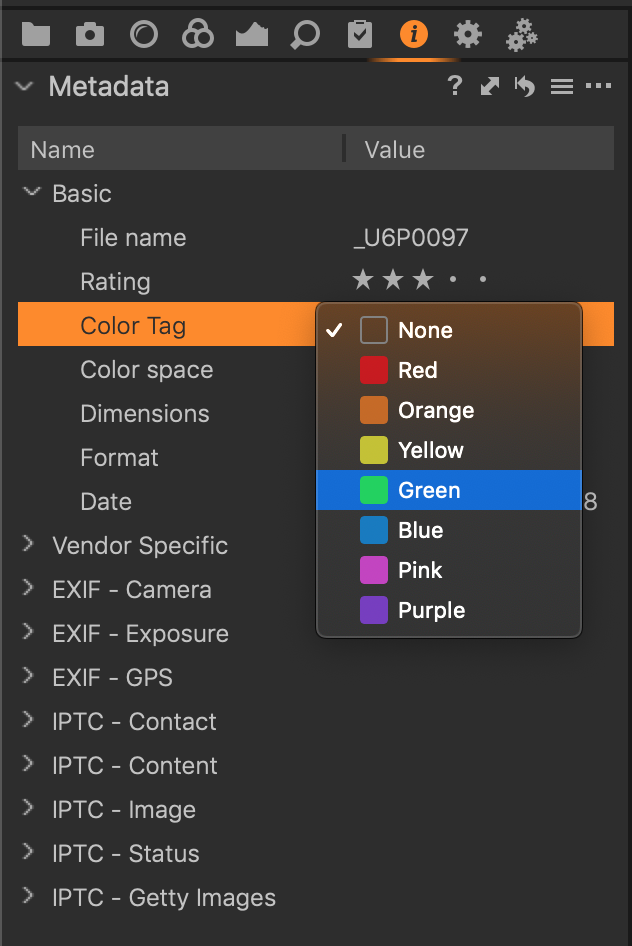
You lot find the most bones information about the image here, similar file proper noun, dimensions in pixels, format, and date. Note that for RAW files, there is no color space. In the RAW field, yous find information about the blazon of RAW, like cRAW for compressed RAW (Sony) or IIQ L for Phase 1 backs.
What is interesting about the Basic grouping is that you tin can read and write both Rating and Colour Tag, but for the Main Variant only, not for a selection of images.
EXIF
There are four EXIF groups, and they all have theEXIF-prefix, except for the Vendor Specific group. In case yous have paradigm files from unlike brands, you could scan through the images while keeping an eye on the fields in EXIF groups.
Yous sometimes detect the camera's firmware in the Vendor Specific > Firmware field, sometimes in the EXIF-Camera > Software field. Phase 1 digital backs utilise the Software field to report the software used for tethering.
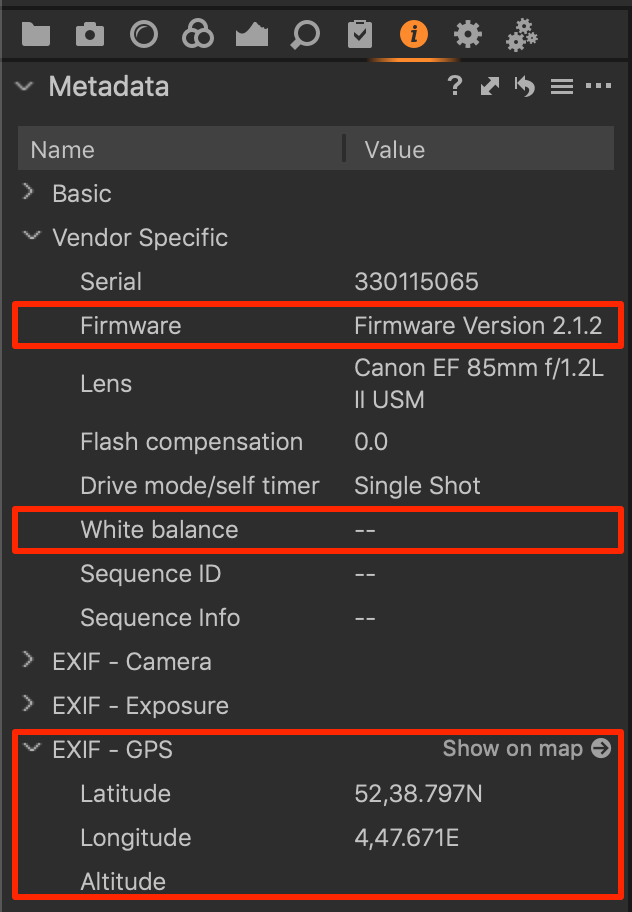
Yous find aWhite balance setting under both theVendor Specific or EXIF-Exposure grouping. Either one is used or both. When you set the white balance in the camera to a fixed value, EXIF-Exposure > White Balance reports Transmission, and Vendor Specific > White residual indicates the called amount.
A group worth mentioning is the EXIF-GPS grouping. Although you can not enter GPS data with Capture Ane, a Testify on map pick appears when there is GPS location information. When you click on this option, it opens your browser with Google Maps at the specified location.

Y'all often can write your name in your camera, either direct from its menu, or via software on your computer. Either fashion, you find your name back in both the EXIF-Camera > Possessor and the IPTC-Contact > Creator fields.
IPTC
At that place are five IPTC groups in the Metadata tool in Capture 1. The last group, IPTC-Getty Images, is for a specific group of users, then allow stick to the remaining four groups.
When you expand the four IPTC groups for the first time, the number of fields is overwhelming. So let u.s. make information technology simple.
Static IPTC
The IPTC-Contact and IPTC-Status contain static information. That means that you can fill in those fields with the same values in the fields each time. I often use a Metadata preset for that and telephone call it the IPTC Stationary preset.

I created that preset for you already, and you can download information technology hither. You load it in your Metadata tool, supercede the information with your values, and relieve information technology again with the same or a new name.
Concluding, yous tin can tell Capture Ane to employ this preset for all images that you import or capture tethered. In the Import Images dialog, Adjustments section, Styles drop-downwardly list, select your IPTC Stationary preset under User Presets. For tethered shooters, go to the Next Capture Adjustments tool, Styles drib-down list, and follow the same procedure.
Dynamic IPTC
In contrast to the more static information in the IPTC-Contact and IPTC-Status groups, the narrative of the photograph is unique. Each epitome can take a dissimilar clarification and location, to name just two fields from the IPTC-Content and the IPTC-Image groups.

In the screenshot above, I wrote the kind information I would commonly put into these fields.
In case yous like to copy specific fields to some other paradigm, utilize the double arrow in the tool's header to open the Metadata clipboard. Capture One enables all fields that take a value. See for more options the next sections on the tool'southward activity carte du jour.
Metadata Tool Action Card
As with most tools in Capture Ane, you open the context or activeness menu with a click on the 3-dots at the correct of its header. There are a few heady options on this menu that I like to discuss with you.
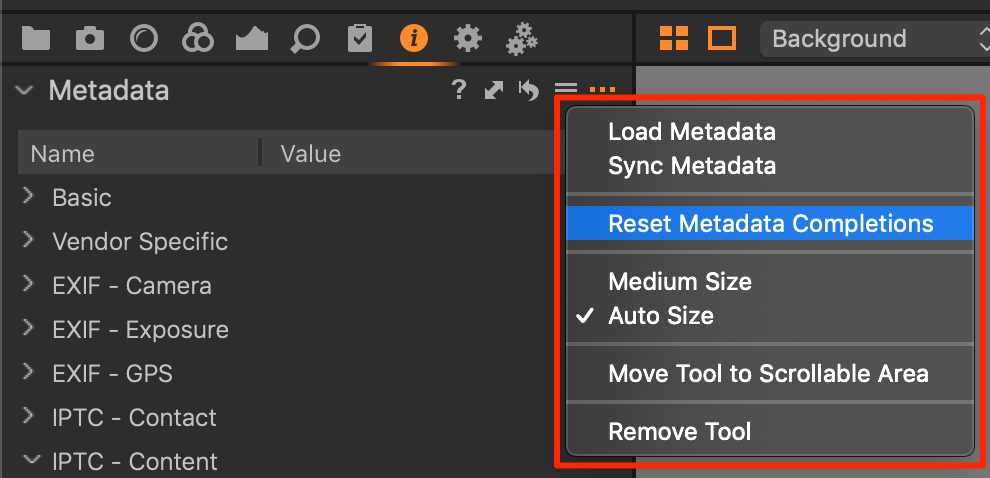
Metadata Completions
The highlighted option in the screenshot above, Reset Metadata Completions, but what does information technology do? Well, Capture One remembers what you typed before in a specific field, and fills in while you lot type. That tin be a great time-saver.
However, sometimes it is counterproductive if you fabricated a typing mistake. Fortunately, you tin reset those completions and starting time with a bare slate.
Load and Sync Metadata
As I explained at the starting time of this postal service, Capture One loads metadata of an image on the starting time opening. If you lot added any metadata to an epitome after this result, you could give the Load Metadata command in the Metadata tool's Activeness bill of fare. Capture One volition reread the paradigm and load any additional metadata.
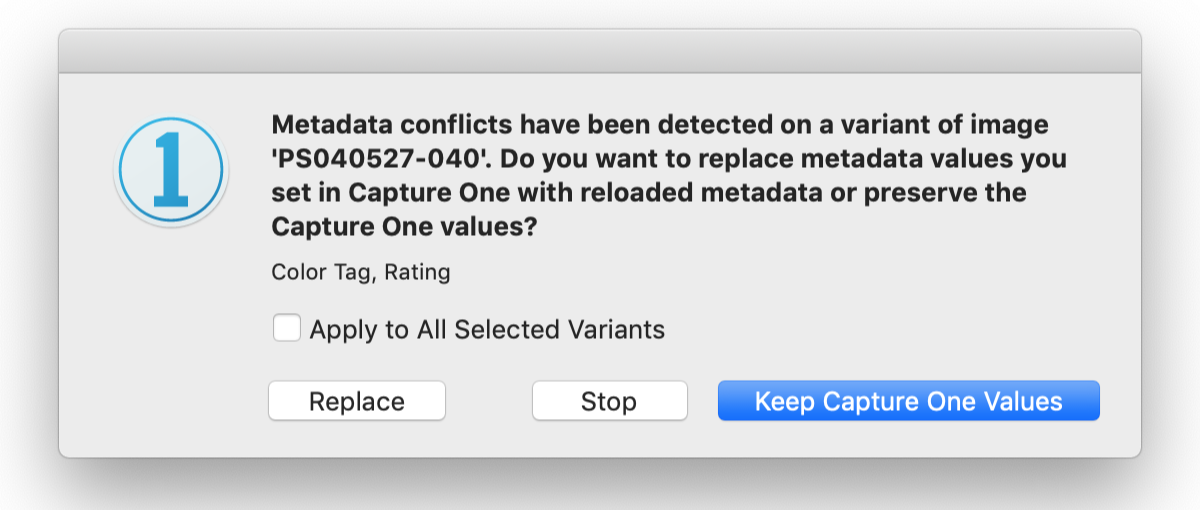
Note that before loading, Capture Ane tin requite the higher up alarm. In this case, the values for Color Tag and Rating conflict between the XMP file and Capture One. If you decide to Go along Capture One Values, information technology loads all metadata except for the conflicting items. With the Replace option, the XMP values will overwrite Capture One values.
The Sync Metadata command works similarly only is bidirectional. It loads metadata just also writes metadata that yous entered to the prototype in Capture One. Because Capture One never writes to the prototype file, information technology will always save the metadata to the XMP file that belongs to the prototype, typically with the aforementioned proper noun and .xmp extension.
I will discuss this in an upcoming mail service where you use some other program to add metadata to your images, either exclusively or with both that programme and Capture One.
Metadata On Output
Calculation all this information to your photos may be a great thought, simply you lot do not necessarily want everybody else to see it. For Your Optics Only, you know the drill. Fortunately, Capture One is that smart too. You accept swell control over what Capture 1 records in the output file.
Each Process Recipe and also the Export Variants feature has a Metadata tab. I skip the Keywords and Workflow options at this moment and focus on the Metadata part on this tab, with its checkboxes.

Capture One leaves the pick Rating and Color Tag always disabled by default, only you lot tin can enable it, of grade. Copyright is an pick you probably like to enable always, in particular, for what yous publish on the web.
Publishing GPS Coordinates may hurt your privacy, so use it with circumspection. And do you like others to see the Camera Metadata from the EXIF? Finally, the All Other Metadata selection lets you lot decide well-nigh the remaining metadata.
To Be Connected
This post on metadata and the Metadata tool continues with a postal service most the Keywords tool and the Keyword Library tool in Using Keywords in Capture I.
Thank you
For reading. Please feel free to leave a comment. Like u.s.a. on Facebook or subscribe to our newsletter to stay informed about new blogs.
Best Regards,
Paradigm Alchemist

How To Make A Custom Metadate Template In Capture One,
Source: https://imagealchemist.net/using-metadata-in-capture-one/
Posted by: frazieryounly.blogspot.com
0 Response to "How To Make A Custom Metadate Template In Capture One"
Post a Comment